In a recent post to his blog, Jack’s Winning Words, Jack Freed used this little quote – “So much of who we are is where we have been.” (William Langewiesche)
Jack went on to write about places that he’d been and to opine that what is more important in shaping us as humans are the other people that we have interacted with and the books that we may have read.
If you look at the little quote from a metaphorical point of view, perhaps a better way to state it is, “So much of who we are is where we’re coming from.” That point of view encompasses everything that is in our background – the places that we’ve been, the people that we’ve met and the things that we have done. Understanding where someone is coming from is important when you are trying to figure out how to deal with them or the situation that you find yourself in with them. It’s that old saw about trying to put yourself in their shoes or see things through their eyes. Where are you coming from?
Sometimes it may be helpful for one to pause and consider where you are coming from as you try to deal with issues in life. It is hard not to let your past dictate your future actions, unless you become more conscious of the impact that the past has on shaping your thinking. Do you reflexively mistrust others because of a bad incident in your past? Does fear based upon some old prejudice drive your reaction? Do you find it hard to allow yourself to love someone because of a bad relationship earlier in your life? Do you get down on yourself because you have experienced criticism and scorn in the past, perhaps even from your parents? Where are you coming from?
Lots of things in our past dwell in our thoughts as we face the issues and decisions of each day. Recognizing that the immediate thought that pops into your head may be an old prejudice or fear that really shouldn’t apply to the situation at hand can at least give you the opportunity to take a different direction. If nothing else, taking the time to have a second thought on the situation may give you the opportunity to break out of the knee-jerk reaction that your past might conjure up. Take time to think about –Where are you coming from?
Keeping that little phrase at hand also allows us moderate our response to others.  Instead of lashing back at some unkind remark, perhaps we might ask, “Where’s that coming from?” and try to understand what is driving the other person to make that remark. Maybe they are just having a delayed reaction to something that they thought you did or they might be acting on bad information. In any event, before we respond in any way we need to better understand the answer to the question, “Where are you coming from?”
Perhaps, just as important is understanding where we are coming from each day. One way to establish a great starting point each day is to begin it with a little prayer.  Beginning each day re-centered on your faith give you a great place to be coming from all day long. You can certainly choose any prayer that you wish that makes you feel good about your faith. I’ve posted here often that I like to start with a very short prayer that gets me in the right frame of mind – “Not my will but Thy will be done.” I know for the rest of that day where I’m coming from. How about you?
Where are you coming from?


 Posted by Norm Werner
  correct some factual error (at least in my opinion) that I think may have just been made in something that is said. Sometimes (probably most of the time) it is better to just let things go, even if you know that what was just said is not correct. Be kind this week.
 view on things, but that’s OK.” Don’t say that out loud, unless you are just spoiling for an argument. Be kind this week.
 stubbornly to a disproved position, it is much better to admit your mistake and move on by embracing the new “truth” of the matter. Perhaps now you will be better able to understand the position that others held all along, which you considered “wrong-headed” until now. You will probably also realize that, had you chosen to be kind rather than right in your position, you would now be in a much better position. Be kind this week.
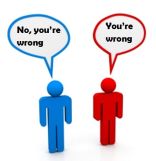 yours. Maybe there is no right and wrong, just two wrongs that will get you nowhere. Life does not have to become as dysfunctional as our current political system, where everything is judged using a far-right or far-left litmus test. There is a win-win middle ground were different opinions and perspectives may be valued for providing diversity to the conversation and where the truth is somewhere in the middle or, perhaps, somewhere else altogether. Be kind this week.
 something nice to say to someone puts you in a positive frame of mind, because you are being positive and not just finding fault with that person. It can be something as small as “your hair looks great today” or maybe just “you look great today”. You’ll probably get a smile and maybe a reply and it will usually be positive, which helps reinforce the positive vibe that you were on when you made the comment.
 Another side-benefit of making the effort to say something nice is that it will usually put a smile on your face, which may be a pleasant change from your normal “at rest” face. It is quite natural that most people’s faces droop a bit into what might be interpreted as a frown by others. You aren’t really unhappy or trying to frown and probably don’t realize that your “at rest” face doesn’t look inviting or friendly. By conscientiously preparing to say something nice you will reflexively put a little smile on your face, which will be a pleasant change for those that you meet.
 NormsMilfordBlog