Have you had your hug today?

November 26, 2012

From the Jack’s Winning Words blog comes this little gem to start the week – “A hug is a great gift. One size fits all, and it’s easy to exchange.” (Unknown).

Hugs are quite common is some cultures and relatively rare in others (such as ours), especially for men. Women in all cultures seem to be much more comfortable with (and prone to) hugging as a greeting. In some cultures hugs are accompanied by kisses on both cheeks; although that too has evolved into a sort of air-kiss bobbing of heads these days.

Deciding whether to hug or just shake hands can be awkward, especially if one party has already stock out their hand for the shake and the other has extended both arms for the hug. My general rule of thumb is to go for the hug, if either side has initiated it. Again, women seem more comfortable turning the greeting into a hug than men. Men seem to reserve hugs for the camaraderie of memorable sports moments or for special occasions like weddings or funerals; whereas women see hugs and a natural everyday thing to do.

I suppose it’s possible to have a heartfelt handshake with someone, but not nearly as effective as the warm embrace accompanied by some whispered sentiment that a hug allows. Of course whispering between men is another no-no in our society, unless it is at that special occasion. I guess men have substituted the pat on the back or slap on the butt for hugs. Those don’t work as well for people that you don’t know well or outside the euphoria of celebrating a special moment.

The really nice thing about a hug is that it usually makes both people feel better about themselves and the other party. So, greet someone with a hug today. They’ll feel better and you will, too.


Give universally but help locally…

November 12, 2012

There are so many very good causes begging for our attention and contributions these days. Almost all are legitimate, although some charity appeals come from fund-raising companies that keep as much as they pass on to the actual underlying charity. The really big causes – cancer, heart disease, muscular dystrophy and such – have huge fund-raising machines going all of the time. They are worth causes and giving to them will make you feel better; however, it’s a short-lived feeling because you just ship your donation off to somewhere and don’t really see how it’s used or any results from your small contribution to the cause. Still, we all need to support those big efforts because they will benefit us all.

There are also lots of local charities and organizations doing good works right in our community. With those, there are not only opportunities to give money; but, also lots of opportunities to o hands-on service work; the kind of work that will give you good feeling that will stick with you for a long time, because you get to see the results.  A couple examples in our area are the Community Sharing Outreach Center Food Pantry and the local Meals on Wheels group.

The Community Sharing Outreach Center appears to be a local group that was started back in 2004 as an outgrowth of programs being run by local churches. It has expanded and added services and now offers the following services:

  • Food/Pet Food – Available once a month and in emergencies
  • Clothing – Available during open hours
  • Emergency financial assistance – This includes evictions, utility shut off and other emergencies.
  • Case Management- Needs assessment, advocacy, networking with and referrals to other agencies for optimum assistance for clients.
  • Educational Assistance – Tutoring in core subjects (K-12), assistance for adults preparing for GED testing.  Tutoring is available for all Huron Valley Schools students who participate in the Federal Lunch Program. You do not need to be a client.
  • Focus Hope – Monthly food distribution site for those over 60 and under 6.
  • The Emergency Food Assistance Program – TEFAP distribution site providing extra food to clients quarterly.

It has been noted here before that the Community Sharing Pet Food Pantry is the only one of its kind in the state that also provides pet food to needy families that otherwise could not afford to keep their family pets.

The Community Sharing Outreach Center is located in Highland at 2029 N. Milford Rd in the old middle school building. They also have a Milford location, which is a community vegetable garden, at the corner of Milford and GM Roads. You can learn more about the Community Sharing Outreach Center and the opportunities that it offers to serve at their web site – www.community-sharing.org .

The local Meals on Wheels organization is part of a larger, national effort to make sure that food gets to shut-ins and seniors. You may visit the national web site at http://www.mowaa.org/  . Locally the web site is http://www.mealcall.org/meals-on-wheels/mi/milford.htm .

This is a simple idea, to make sure that seniors and shut-ins don’t go hungry; however it takes a lot of work by a lot of volunteers and a lot of contributions to buy the food that is needed. I’ve put a flyer on my Move to Milford web site about the volunteer opportunities for Meals on Wheels at http://www.movetomilford.com/meals_on_wheels.html .

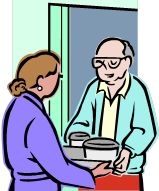
People who need meals can call two locations – the Milford Senior Center at 248-685-9008 or directly to the Meals on Wheels coordinator at 248-684-0705. If you are able and interested there are plenty of opportunities to help with this effort. I can tell you, based upon my personal experience of delivering food baskets to needy family through my church, that nothing will give you a better feeling that seeing the smiles of people who were facing another day of hunger if you weren’t there with some food. Call them today and volunteer to make, pack or deliver food to those who are shut-in.

Another avenue for local volunteering that will make you feel great is through the many local organizations with a focus on programs for children and families, such as the Carl’s Family YMCA, the Milford Library, and the Community Education and Recreation through the Huron Valley School District. There are links to all three of those organizations and their program calendars on my web site – www.movetomilford.com. I’m sure that all of them can always use more help.

Local, membership-based service organizations like the Rotary Club and the Optimists, as well as organizations like the Knights of Columbus also have multiple fund raising events for worthy causes throughout the year. And, of course, all of the local churches are always working quietly behind the scenes to help families in need. Churches run on volunteer help, so ask how you can help at your church.

There is an old saying that I’ll paraphrase by saying “you get back by giving.” No amount of money in your paycheck can make you feel as good as you’ll feel by volunteering for organizations like these and helping others. Yes, we still need to give money to these and other worthy causes, both local and national; but it’s these local organizations that need and can use your help and time to make a difference. Call one of them today and ask how you can volunteer. So, rather than just hand off some money; get the hands-on experience of actually doing the work. It’s great!


Don’t let your errors become mistakes…

October 21, 2012

“An error doesn’t become a mistake until you refuse to correct it.”- Orlando A. Battista 1917 -1995, Canadian-American Chemist and Author.

I saw that quote in a post on ActiveRain.com, one of the real estate sites that I frequent and have a blog on. I’d probably add that you first have to acknowledge the error, which all too many of us have problems doing in the first place. You can’t move on to the correcting (or not) stage unless you first come to grips that you have made an error. In fact, it’s probably the refusal to admit the error that really turns it into a mistake. The refusal to correct the error just compounds the mistake.

It is human nature to have some trouble admitting to an error. Sometimes that can be as simple (and as obvious) as going in the wrong direction when trying to get somewhere. Of course, if you’re a man, admitting that you are lost and stopping to ask for directions is very hard. Another obvious error is “finishing” the assembly of something only to find that you still have some parts left over. Oops! 

person who misspokeSometimes the error may be very difficult to recognize. That happens a lot when human feelings are involved. Maybe the error was just a remark dropped innocently into a conversation. Maybe that remark was meant as a joke but wasn’t politically correct. It’s easy to miss that slight pause in the conversation or the flush on someone’s face as they react to something that you just said, but many times you’ll sense it.

You may not understand why something you said caused the reaction from the listener. It’s not always easy to figure out in the midst of the conversation how to recover or to correct the error. You may have to ask someone else, later, in order to find out what it is that you might have said that offended or caused the person that you were speaking with to react. Many times you’ll find that you’ve inadvertently hit a nerve that is still raw from some traumatic event in that person’s life, like a death or divorce or perhaps there are family things that you’ve somehow been insensitive to, like a having an autistic or special needs child in the family.

The key is not to let that error become a mistake, by refusing to acknowledge it and not trying to correct it. It may be hard to go back to someone with whom you had a conversation and made some remark that you later found was probably offensive or insensitive from their perspective; but it is important to do so. Otherwise they will forever have this little flag that says “jerk” in the back of their minds that is raised whenever they see you. Don’t let your error turn into an uncorrected mistake. You’ll feel better and so will they.


Want no more…

October 18, 2012

“If you don’t get everything you want, think of the things that you don’t get that you don’t want.” (Oscar Wilde) – from the Jack’s Winning Words blog.

I’ll bet that most people reading this saying would immediately think of bad things that they don’t want, such and a disease or some disaster; yet there are many things in life that aren’t bad , but which are just things that we don’t want. At one time I thought that I wanted a motorcycle; but then I realized that I really don’t; it was just fun to think about for a while.

I suspect that most of us would immediately think of material things when reading a saying like the one above; although some with lingering illnesses might just wish for good health. Some might even have wished for world peace, but might have to be happy if we don’t get another war in some far-flung place.

The most common advice for what to do about not getting everything that you want is to be thankful for those things that you do have. You could also think about all of the things that you wanted and got that it turns out you don’t use or found that you really didn’t like. Our garages and basements are full of that kind of stuff. Wilde didn’t include need in his thought.

It’s relatively easy to just say “don’t waste time thinking about stuff that you can’t have”; but we all waste a little time doing that. Perhaps Oscar Wilde’s advice to spend time thinking instead about stuff that you don’t want anyway will work to distract us from dwelling on things that we don’t have. That we wanted.

And, if you just don’t get all of this, perhaps it’s because you just don’t want to.


Either you will or you won’t…

October 17, 2012

“The difference between perseverance and obstinacy is that one comes from a strong will and the other from a strong won’t.” – Henry Ward Beecher in the Monterey County California Herald.

Many times we tend to see ourselves as persevering in situations when in reality we are just being obstinate. I know that it was obstinacy rather than perseverance that kept me out of the foreclosed homes game. I was adamant (obstinate) about not getting dragged into some of the muck that was going on in the early days of the housing crisis.

By not being flexible and not allowing myself to find a way to work in a positive fashion with foreclosed homes, I missed that opportunity. Not all listing agents back then were sleazy, just enough that it made me cringe to think of joining their ranks. A few good agents held their noses and jumped in and eventually made the whole process better by bringing better practices to the process. Good for them.

I initially shied away from the short sale market, too; initially not willing (obstinate) to put up with the long delays and need to spend so much time in the frustrating process of negotiating with bank clerks who didn’t seem to care about anything. Fortunately I found a good short sale partner to handle the stuff that I really still don’t like and allow me to do the real estate parts and the interface with the sellers, which I enjoy. I’ve been very successful at short sales.

From time to time, I suppose it’s advisable to try to take as honest a look at your life as is possible (and maybe get a second opinion) and evaluate which of the things that you believe you’re being persistent about might just be cases of being obstinate. Ask yourself is if these are things about which you have a strong will to accomplish or a case where you just refusal to admit that your goal was wrong in the first place. Sometimes it’s better to let go and move on than to persevere towards the wrong goal. Let a strong will rule your life, not a strong won’t.


Don’t delay, time doesn’t wait for you…

October 12, 2012

“You may delay, but time will not.” (Ben Franklin) from the Jack’s Winning Words blog.

Procrastination is an all too common human tendency. The ability to convince ourselves that we’ll get to something later is way too easy and all too convenient. Unfortunately, so is the resulting cases of “coulda, woulda, shouldas” that tend to follow. You coulda taken the time to call that expired listing and you woulda gone and knocked on the door of that FSBO, ‘cause you know that you shoulda been doing more prospecting all along.

Procrastination is one of the biggest issues that I have to face every day. It is just so easy to convince myself that sitting here writing a blog post is a better use f my time than prospecting – or at least it feels better. And at the end of each day, there are things that I can look back and say to myself,” I shoulda gotten to that, maybe tomorrow.”  I’m gonna work on that tomorrow.

Some of the biggest regrets that many people have revolve around things they put off doing – visiting that sick relative or friend before they passed away or perhaps not taking some action to stop or prevent some neglect or abuse before it was too late. Many people look back over their lives and feel regret for not having been more generous or more involved with charitable works. Some feel remorse for relationships gone bad that might have been saved by timely action. Because of a fifty year celebration that I missed, I recently learned how many of my old classmates from high school are already gone and regretted not having made the effort to stay in touch somehow.

Time marches on with our without us in tow. Things don’t stop happening just because you hesitate or delay; they just happen without you. Potential clients will buy goods or services from someone else, whether you call on them or not. Not calling just assures you another coulda, woulda, shoulda moment. So don’t delay. Make the calls today and you’ll always have plenty of things to do tomorrow. And in your personal life, don’t wait to call that old friend or relative until you get word that it’s too late. You can’t really talk to a memory – call today.


When you lose,make it a win…

October 9, 2012

“You gotta lose ‘em some of the time. When you do, lose ‘em right.” (Casey Stengel) from Jack’s Winning Words.

Casey was talking about baseball games of course; however, his words ring true in business, too. We don’t always win, whether it’s a multiple-bid situation or competition for a listing. Don’t you just hate it when you hear someone whining or bad-mouthing over a lost sale or listing? Stuff happens and it does no good to try to bad-mouth the competition or whine that you got cheated out of a sale. Rather that you should use the incident to try to learn what you could do differently or better the next time.

The ability to look back over a losing situation and see what you did and didn’t do that might have affected the outcome is not necessarily an easy skill to develop. Human nature licks in right after a loss and the tendency to find someone or something else to blame is a strong human protection reflex (at least it protects the human ego, which often refused to believe that you could have done anything wrong yourself).

Eventually logic kicks in, along the realization that if you didn’t do anything wrong and yet you lost, there must be something else you could have done (or done better) to win. One very consistent characteristic that you’ll often hear about winners in sports (no matter what sport) is that they are “students of the game.” Sports greats like Michael Jordan and Tiger Woods have often been called students of the game. They study the history of the game and learn what things impact success or failure. Quite often athletes like that go on to become coaches in their sports.

In business (including real estate) there are lots of books and courses available to help students of the game better understand every aspect. Even people who are naturally outgoing and friendly need to understand the nuances of the business game that they are in; otherwise they just become that great fellow that everyone loves, but who never seems to succeed.

So, listen to Casey’s advice and when you lose one, lose it right – learn from it. Discuss it with someone; preferably someone who can help coach you through the process of learning from it and making changes in your approach the next time. If you are just starting out, seek out a mentor in your office – someone who will work with you to learn the ropes and develop your skill at learning from mistakes or losses.  It does no good to beat yourself up over loses. Turn them around into teaching moments and benefit from them.


Occasionally let the fairies and elves return…

October 6, 2012

There is an age of innocence when fairies and elves, trolls and witches are real to us all. Usually that is a very young age and we all “outgrow” that age and that innocence all too fast. We don’t actually outgrow it, we are forced to give it up; dragged into the world of “big boys and girls” who don’t believe in that stuff by adults and older children. It’s sad really, because the world of imagination that is abandoned in that passage into the “big” world is one of wonder and delight.

I remember one summer when my eldest grandson was little I would occasionally take him on walks with our dog, Odie. There is a small area of dense woods close by, behind the Muir Middle School, of not more than an acre. Those became the magical “woods” that he and grandpa walked through that summer. It was magical because someone (or something) had built a series of little shelters amongst the fallen trees and limbs in those woods.

These crude little shelters that we found in the woods were not much more than a few sticks stacked carefully against a fallen tree trunk, or sometimes free standing, with a few boughs on top to form a roof. They each clearly had an entrance. I’m sure that someone had great fun making them, perhaps as little shelters for rabbits or other small animals. Each little “house” was only a foot or so tall and not much more than that around. So, I told my grandson that these were the houses that the fairies and elves of the forest live in and he had the best time imagining that this was true and telling his mom about seeing their homes.

Of course the innocence that allowed him to believe that there were fairies and elves in the woods and that we had seen their homes didn’t last. By the next year he was already questioning who had built those little shelters and why. He had already become a big boy. The fairies and eves were gone for him.

It was, on one level, that age of innocence and the ability to believe in fairies and elves and dragons that was the subject of the famous Peter, Paul and Mary song, Puff the Magic Dragon. Of course the big boys of the world saw a different level and meaning to that song; but the songs story played out much the same as my story with the little houses. For a while the magic of innocent imagination allowed Puff the Magic Dragon to exist and then he disappeared under the sobering weight imposed by growing up.

There is still within us all a capacity to recapture a moment or two of that wonderful childhood innocence. Most of us are too much “in control” to allow those moments to happen; but some can relax, sitting by a campfire on a cool Autumn night, perhaps with a small creek babbling away nearby, and allow our minds to wander and our eyes to defocus. In those moments, if you let them back into your lives, you might see the fairies dancing in the flames of the fire or hear the elves scurrying around the edges of the campfire light. No one else need see the smile that will come to your face when the fairies and elves return.


Never grow too old…

September 28, 2012

From the Jack’s Winning Words blog comes this tidbit – “We never really grow up. We only learn how to act in public.” (A Paraprosdokian) How many of you know the word, paraprosdokian, without looking it up? And yet, it’s something that we use regularly to create humor. To see examples, click on the link below.

http://www.englishforums.com/content/humour/paraprosdokians.htm

How true it that! The mark of an adult is often how well he/she has learned to act in public. Get them out of the public eye and one will often re-discover the kids that are still in them. I’m reminded of this most mornings when I see myself making a goofy face in the mirror as I prepare to shave. One can not, as an adult, make goofy faces out in public; although I will occasionally do one discretely to make my wife laugh.

It’s the kid in us all that keeps us young, that allows us to play occasionally and provides unguarded moments of pure joy from time to time. I’m reminded of another saying – “It’s not that we forget how to play when we get old; it’s that we get old when we forget how to play.”

So as you go about your daily adult routines, behaving properly in public; if you get the chance sneak a peek at a mirror and make a goofy face. You’ll feel better if you do. After all, you’ve got the rest of the day to act properly in public.


Focus upon your own goals…

September 26, 2012

“Ultimately, we all have to decide for ourselves what constitutes failure, but the world is quite eager to give you a set of criteria, if you let it.” (J.K. Rowling – from the Jack’s Winning Words blog.

Rowling sure has that right; however, sometimes I think we are actually harder on ourselves than the world at large. Maybe that’s because we know what we were trying to do or because we see some little thing that is wrong that the rest of the world can’t even see. So, some times when the world is trying to pat you on the back and say “great job”, let it; instead of giving yourself a “Yeah, but.”

I also don’t agree with the self-esteem zealots who want to give everyone who shows up a trophy for trying. There is value in having measurable goals or standards and providing rewards for those who achieve them in sports and other pursuits in life. If nothing else, there is a personal sense of accomplishment at having achieved some goal or accomplishing some task.

If, at the end of a project or event, you can look back and honestly say that you gave it your best, whether you reached the goal or not, it can work as a personal victory and a motivator for your next try. You will often hear that some runner or other athlete has just accomplished a “person best”, which I’m sure they will take as a personal victory, whether others around them see and appreciate that or not. Once you’ve achieved your personal best, you can set the next goal for yourself.

So, like Rowling recommends; you have to decide at the end of each day which things you feel good about and which things you still need to work on improving. If you give yourself a break and wait for that end-of-the-day perspective, you’ll likely be less hard on yourself and find inspiration to continue to improve in many areas of your life. There’s less room for thoughts of failure to creep into your life, if you are always focused upon improving and moving the bar up another notch.