Appraisal issues a never ending battle…

November 8, 2013

As much as the market has been straining to break out of the recent recession and regain lost property values, one component of the market has been acting as an anchor, holding back or at least significantly slowing the positive progress. That component is the dreaded appraisal. I say dreaded, because it has become the biggest obstacle to sales these days. The house can be house valuein move-in ready condition with a clean bill of health from the home inspection and still have the sale queered by a low appraisal. That’s happening a lot these days. Why is that?

One of the constant battles that go on in the real estate market is that between the Realtors involved in listing the houses and the appraisers over what the market value of the house should be. Appraisals can be the cold splash of reality in the face for many sellers. Appraisals take all of the emotion out of the process of putting a market value on your property.  The battle over market value is one that is likely to continue forever, just due to the different natures of the two sides in this arguement.

Realtors, especially listing agents, tend to be optimistic and they also tend to bake the direction of the market into their listing pricing. In a rising market, like we have now, it is quite easy to miss the market on pricing, either low or high. If the listing agent prices the property too low, it might sell quickly; but, the seller will not have gotten the most out or the sale. If, on the other hand, the listing agent is too aggressive with pricing the property for a rising market, he may price it too high and it will just sit there, waiting for the market to catch up.

Appraisers go at value pricing from a different perspective. They are required to use sold Appraisercomparable properties as a barometer of the market; thus their data is always trailing the market, sometimes by as much as 6 months. In a rapidly rising market that almost always means that they miss the value on the low side. For a long while appraisers were also forced to include the sales of foreclosed and short sale properties in their comparable properties. Fortunately much of that business is behind us now, but there are still a few of those types of sales that were done in the last few months that can affect appraisals.

Another major factor in many appraisals is something that the seller can’t do anything about – the style of the house. House styles come and go, with each decade usually having some dominant style. There are a few “classic styles” – ranches and colonial, for instance, that never really go out of style, but which might be less desirable than a more modern architectural style. For the past couple of decades the 1 ½ -story or Cape Cod seems to be the preferred style. Split levels, which were all the rage in the late sixties and seventies, have really fallen out of favor as a style. Those style preferences show up in the appraisals. Bi-levels, tri-levels and quads definitely appraise lower than ranches, colonials and Cape Cods of the same size. Homes that were sometimes classified as modern or contemporary when built can also fall out of favor, since many of them have very unusual floor plans.

What can you do about all of this as a homeowner who wishes to sell? Not much about the style issue; but you can make sure that your house is the best one of whatever style that it is on the market. A house in great, move-in ready condition will still attract buyers. Another thing that sellers can do is to compose a list of the updates and upgrades that they have put into the house, hopefully not too long ago. It is not obvious to the appraiser exactly when the roof was replace or a new furnace put in, but those things make a difference. Some updates, like granite countertops will be obvious, but many others may benefit from being pointed out for the appraiser. Taking care of the many little “deferred maintenance” items that you may have been putting off can also help by removing those value detractors.

Another thing to do is seek professional advice. Get a good Realtor to do a Market Analysis for your home and then follow his/her advice. You don’t need to fight with both the Realtor and the appraiser. Call me and I’ll help you understand more about the market value of your home and what you can do to improve it.


September Market Report

September 27, 2013

The Fall starts the seasonal slow down for home sales so we can expect fewer multiple offers. We will still see the vast majority of homes (over 85%) sell within 90 days or less. For Buyers in a bidding war, our rule of thumb has been, “as long as the offer is at or below the peak 2005 value, the overbid is a safe bet.”


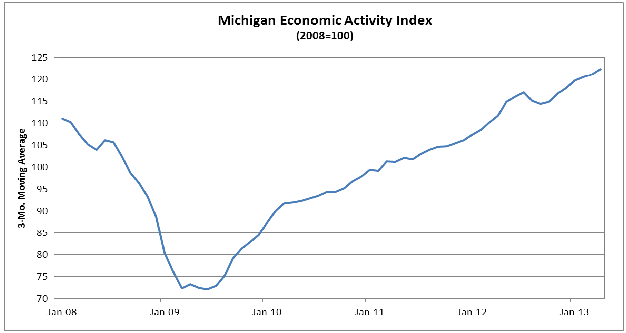
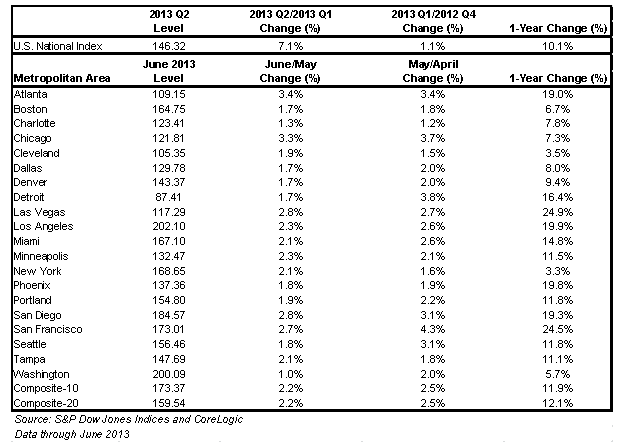
I have included two charts, Comerica’s local economic trend and the latest Case-Shiller value trend. Both show good news for housing and our local economy.


The Comerica Michigan Economic Activity Index continues to show strong growth through this summer, surpassing the prior 2007/08 high points. This represents the fuel for sustaining our local housing growth trends.


Case-Shiller shows Detroit with one of the highest year-over-year value growth rates. Although we are the only major city still below our 2000 value baseline, that is heavily influenced by the decline in values for the city of Detroit (the good news is city values are rising quickly again). The typical Southeast Michigan market is at or above 2000 values.


The area around Milford that I tend to focus upon has done a bit better than the regional numbers would indicate, but the trends are similar. Our area is probably back to about 2004 levels for prices, still below the peak but better than the harder hit areas like Detroit, Ypsilanti and Pontiac. Home values are up in this area anywhere from 16 – 20% year-over-year, but remember that they are starting back up from a drop of anywhere from 30 to 40% in value, so it will take more time to recoup the paper losses that occurred. It is important that you get an updated market value for your home if you are thinking about selling. Things are changing too fast to rely on an old number, where the term “old” means 2-3 months ago or longer.


Real Estate Market Reaching Equilibrium

August 12, 2013

scalesSeveral reports from various industry sources seem to reinforce the notion that the housing market is moving back towards equilibrium from it frantic pace of recovery early this year. The prime indicator is the lack of a big jump in prices between June and July of this year. Prices still went up, but not by double digits as was the case earlier in the year.

I suppose that a would-be home seller might like the rapid recovery to continue a while longer, but it is really a good thing for the market overall that it pause to cool off a bit. The rapid run-up of home prices, combined with an increase in mortgage rates served to lock out many first time buyers.  There was also a bit of” wait for it to go up more” greed going on that kept the inventory low and fueled the value increases. Many of those who waited may find that they will not be any better off and may have missed the very buyers they were hoping for.

One segment of the potential buyer pool  –  those who felt that they had to buy and get in before school starts in September – have already made their selections.  Closing by September 1st pretty much meant that you needed to have a signed deal by August 1st, in order to allow enough time for the mortgage company to get the deal underwritten.

The “prime” selling season is generally in the months of May, June, July, and August; however, the good selling season lasts until Halloween. After Halloween, things slow down quite a bit as people start focusing upon the Thanksgiving and Christmas holidays. After that it’s winter, which is always a slow home sales season.

So we still have some good selling months left in 2013, if you were thinking of selling and we have some more stable months ahead if you are looking to buy. Mortgage rates have stabilized a bit, although they are expected to continue a slow upward creep. More inventory of homes is coming on the market, which is good for buyers, too.  Home builders have also cranked up production, so more brand new homes are available, or will be shortly.


The Realtor Code of Ethics

July 29, 2013

“It is not the oath that makes us believe the man, but the man that makes us believe the oath.”  (Aeschylus) from the Jack’s Winning Words blog.

Wow, Aeschylus must have known a Realtor!  The same can certainly be said about our Realtor Code of Ethics. Having the NAR Code of Ethics is oft pointed to as an indication that being a Realtor is a profession and not just a job. I suppose there is some truth to that, but probably there is more truth in Aeschylus’ words (slightly modified to fit here) that – It is not the Code of Ethics that makes us believe the Realtor, but the Realtor that makes us believe the Code of Ethics.

The Code of Ethics in and of itself is a wonderful document; however, if the people involved in the day-to-day practice of real estate see them as something to be bent or ignored altogether, they are just words. That’s why it is the responsibility of every Realtor to not only live by the Code, but to report those who aren’t. There is no room to look the other way when you see a Code violation, because doing so demeans the profession and all who practice it.

The reason that the Code exists in such detail is that too many people in real estate are not ready to live by simple, golden rules, such as “do unto other as you would have them do unto you.” Somehow their value systems have become so distorted that they stop after “Do unto others.”

There are still lots of things in the normal day-to-day life of a Realtor that are not covered by the Code, such as those who feel they need to bully their way through a deal or that they only win if the other side loses in negotiations.  Even a well written Code of Ethics can’t help there – it’s not a Code of Acceptable Human Behavior.  You still have to put up with boors in real estate as in life; but at least it’s a start.

So don’t be taken in by the admonitions of “Don’t be such a hard-ass” or “Everybody does it”; if you are involved with a Realtor who is obviously breaking the Code, report it to your local board.  It’s not being hard-ass, it’s being honest and that is one of the bedrocks of the Code to begin with. We are all better off because we have the Code of Ethics, so we also need to be diligent about making sure that it is followed by all.

The Realtor Code of Ethics is celebrating it’s 100th year in existence this year. You can read about that and read the Code itself at – http://www.realtor.org/topics/code-of-ethics-centennial


Suspend your disbelief, be a Realtor…

July 27, 2013

There is a saying or phrase associated with movies which alludes to the fact that in order to enjoy a movie one has to be ready to suspend disbelief – to be ready to allow the story on the screen to unfold and to take it all in as if it could actually be happening.  Some movies are easier than others in which to accomplish this state of suspended disbelief.  Many movies purport to be based upon real happenings – events that were in the news or at least about which one may have heard. Other movies are pure fantasy, such as Star Wars; however, one can temporarily suspend disbelief and imaging that somewhere in a galaxy far, far away…

Suspending disbelief in real estate has more to do with actually dealing with “I can’t believe that that just happened” scenarios than it does with imaginary situations. In real estate one must get used to dealing with things that no rational human being might imagine would happen, but they do. Most of this has to do with the strange goings on behind the various curtains that veil the real estate process from the prying eyes of the public, the agents and the buyers and sellers.


There are many places within the flow of a real estate deal where logic and common sense often require temporary suspension.  There are the sometimes totally absurd requests/requirements of the mysterious underwriters, such as “provide a written explanation from your mother and her bank about where she got the $100 that she gave you for your birthday.” There are the sometimes incredible demands of the buyers or the sellers over some minor point – a point that usually equates to less than 1% of the total deal, but for which the parties are willing to sink the entire deal, an example might be the seller who is willing to “buy his house back” for the $100 repair that the buyer has asked him to make.


There are also the pesky inputs and demands of the minor character players in the deal – the requirement for some minor thing from the insurance company, in order to write the home owners policy; the reluctance of the title company to provide a title policy without objections on almost anything but a new-build house (which is really an indication that they don’t trust their own examination department); and the other mortgage player that shall forever remain behind the curtain – the PMI company – who, for whatever reason that shall remain a mystery,  is holding things up. Like the movies, we’ll never know why these villains do what they do, because there is no transparency into the process at all.


The parallel between the movies and a real estate deal also cover the emotional roller-coaster that I’ve written about many times before. Every day, from the time the offer is accepted until the closing is over, can seem like the players are living in an action movie, with the need to have a fight scene or chase or blow something up every few minutes. . There are emotional ups and downs on a daily basis. An issue is raised and elevate to the level of a panic …and then solved – and then it happens again the next day. Day after day there is an emergency…a panic… and a solution (OR NOT).  Each deal might easily provide the fodder for a television reality show season.


So why do we – the Realtors involved – do this? What can possible justify having to deal with such an emotional cauldron day after day? I could be cynical and say “because we love it.” We don’t love it. No one can claim to love the gut-wrenching roller coaster ride that real estate deals may take you on. I think we love the fact that we are good at dealing with it;  of handling not only our own emotions, but those of the clients involved. Perhaps “love” is the wrong word there. We may feel good about the fact that we are “able” to deal with crises when all around us are panicking.


One of my very perceptive clients recently made the comment ( in the midst of an especially difficult and very emotionally charged deal) that I seldom displayed emotions during the things that had been going on. I told him that many of the things that had happened had evoked emotional responses from me, but that someone had to maintain the only cool voice of reason during the whole ordeal and I had chosen to take that role. When all of the other parties are screaming and crying and letting emotions run rampant, someone has to step out of the maelstrom and provide unemotional guidance and counsel. I had chosen that role, as I often do.


I’ve actually had clients accuse me of taking the other side – of not representing their interests, but rather that of the other side – in the heat of the emotions of difficult deals. That was not the case and never is.  Most have had time to reflect on events later and have come back to thank me for not joining them in their emotion-driven efforts to sink the deals.


Real estate deals can often be (and are too often today) very emotional.  Things can happen that require that you suspend disbelief and just go with the flow. Things can get so crazy that all around you are screaming and shouting and threatening each other (and sometimes you). If you can’t suspend your disbelief and control your own emotions, maybe you shouldn’t be in real estate.  It’s a great show, if you know how to just let it happen and roll with the punches that it will throw. Otherwise, go be a ticket-taker at the movies. You’ll get to watch for free and maybe you’ll learn to suspend your disbelief.


Tough market for buyers…

June 20, 2013

I was quoted this week in an article in the local Observer & Eccentric Newspaper about the current real estate market that we are in and how tough it is for buyers right now. Read the article here…

http://www.hometownlife.com/article/20130620/SPECIAL-SPECIAL%20SECTIONS/306200312

It’s tough on Realtors, too. I’ve sold all of my listings off and I’m trying to get more, but people still seem reluctant to list. Finding homes for the 4-5 sets of buyers that I’m working with is really tough in this market, so we need to be patient and persistent.


Southeastern Michigan Market Report for May

June 12, 2013

Ed. – The report below is from our broker – Dan Elsea – who sees things from a different vantage point that I do or than any individual agent would. Dan bases his observations onthe data that had come in trhroughthe end of May.

DAn Elsea

Dan Elsea – Broker for Real Estate One

In the last two months we have seen the first sign that the market may be moving towards normal. Even though sales continue at a fast pace, new listings entering the market in May were higher than last May, the first year-over-year increase in nearly two years. Although most all indicators show a market heating up (the Months’ Supply of Inventory (MSI) hit a record low of 1.8 months in Southeast Michigan and three year low of 6.5 in Northwest Michigan), underneath those numbers are some signs that Sellers, who have been waiting for years to sell, have noticed the price jumps and are testing the waters. If this trend continues it will lead to a smoother market with more listings and appreciation rates in sustainable single digits. Increasing interest rates will cool some buyer demand as well. Even with a more normal market it will still lean towards a Sellers’ Market, with Buyers outnumbering Sellers because of the buildup of Gen X and Y’s entering the housing market.

Home values are continuing to rise in Southeast Michigan at double-digit levels and high single-digits in Northwest Michigan. All markets are improving quickly but some are moving faster than others. By price segment, the under $500,000 market is rising the fastest at over 12%, while the over $500,000 market is moving at around 7%. Within specific submarkets the numbers are even higher.

Most all MSI’s are at their low points, ranging from a low of 36 days (Redford) to a high of 3.8 months (Ann Arbor), with most markets under 60 days. In the last two months the most active markets in Southeast Michigan have been Plymouth, Troy, Northville, Redford and Southfield. In the most active segment (under 90 days listing category) for each of those markets, the Months’ Supply of Inventory has actually been zero (i.e. at the current sales pace all listings under 90 days will sell). Washtenaw County is the only market where the MSI is higher compared to last year as a result of both a slowing sales pace and an increased pace of new listings. However, Washtenaw was the first market to move into hyper activity, so it is not surprising it might be the first to settle back to a more normal pace as more Sellers react to the improving market.

Ed. – This report is good for buyers who might now be starting to see more homes to choose from in the market. For seller’s it’s not really bad news; however, it does portend a shift back to more normal sales scenarios and away from the wild, multiple-offer situation that we’ve recently experienced in the market. Sellers also need to refocus back on the basics of keeping the house ready to show and not getting too greedy with buyers.


Up, up and away…

June 9, 2013

Report after report continues to show home prices climbing at double digit rates so far this year – 10% a month ago, 12 % this month and projected at 13% next month. IS this cause for concern that another value bubble is forming in the housing market? Not really. This run-up in prices is driven by a single factor – the huge shortfall in inventory, when compared to the demand. It is also being tempered by conservative appraisals that are lagging a bit behind the market prices. Also, even though lenders are back to offering products like the old 10-10-80 mortgages (10% down, a 10% equity loan and an 80% mortgage) they are certainly not offering no-doc loans or lending to people with marginal credit scores.

breakeven

So we aren’t really seeing another bubble, which was the result of the combination of bad lending practices and an over exuberant market; rather we are seeing a classic example of the supply-demand curve in action. Once the market reaches a point of recovery in values that will allow more people to put their homes on the market, we’ll likely also see a re-balancing of the market back to one where neither the sellers nor the buyers have the advantage.


Like any system that is springing back and forth between too much and too little, this market will eventually find that equilibrium point. In the meantime, hold on and enjoy the ride!


The May Market Report from Dan Elsea

May 24, 2013

Dan Elsea is the Presidentof the Brokerage side of the business for Real Estate One and sends out market reports to all ofhte offices each month  that use the perspective that he has of the entire Michigan market to give us better insight into what’s happening in the Michigan market overall. Here is his report for May, 2013.

The real estate market continues its wild ride into summer. This is the most active market we have seen in Michigan. The Months Supply of Inventory has dropped to 37 days for the majority of the market, not yet to the two weeks of inventory that Las Vegas has, but still the lowest we have recorded. So are we headed for another bubble? The answer is both yes and no, but mainly no.

Cash sales are near 40%, lending standards are still very tough, housing affordability is at record highs and values remain 25% off their peak. All of which serve as insulation against another bubble. The added equity being created by the rise in values is strengthening a weak economy, as opposed to overheating a strong economy (which was the case in 2006). So, we have some room to play with before there is any significant bubble.

On the “yes” side, however, values are rising faster than the economy should dictate. Because home values are so affordable, many buyers can also afford to overbid. But there will be a natural cap on a “bubble” getting too high. Looking out to late 2014/2015, appreciation rates will move down to a more normal level from the 1-2% per month we are seeing now. This is due to interest rates inevitably rising and buyer demand slowing, as the pent up demand from the past six years levels off.

The annual appreciation rate should have a bubble look as appreciation rates peak over this year and the next and then settle back down to a more typical rate.

Annual Apprciation rate in MIchigan - May 2013

Following the rate at which different housing indicators are changing is a good way to see just how quickly a market is moving. The rate of change compares the percentage change from one month to the same month the prior year. For example, new listings in February of this year might be 20% lower than last February, but the March comparison was off only 10%, which means listing inventories are still falling, but at a slower rate. The charts below follow the rates changing over the past year for new listings, pending sales, days on market and price per square foot.

We are seeing the first signs that listing inventories are starting to stabilize. On the chart below, the green trend line follows the rate of change in new listings coming on the market compared to the prior year. From June 2012 to February 2013, fewer new listings were entering the market each month. In March and April of this year, the rate of new listings continued to fall, but at a much slower rate. This shows it is getting “less worse”, which is a positive trend! Buyer demand (the blue line) has also been accelerating in March and April, absorbing any and all new listings and not surprisingly the average days on market dropped dramatically, as well. If these trends continue, we can expect inventories to continue to tighten through the summer, even if more listings hit the market, since buyer demand continues to rise.

rate of change chart for listings and contracts

Using price per square foot as a value indicator, the rate of appreciation began accelerating dramatically last summer and has leveled off some in the past few months (it can’t go up forever).

month over month rate of change in cost per sq ft

April of this year was our strongest month since June of 2006 in terms of homes sold, a solid indicator of just how far the market has bounced back. We have moved from the pan, into the fire, from the dog days of 2007-2010 to today’s wild market, each with their own challenges and opportunities. This market is much more fun, but no less exhausting!


Video Market Update from our Broker

May 21, 2013

Our fearless leader and the head broker for Real Estate One – Dan Elsea – has started doing a video market update and I thought I’d share that with all of my readers. It basically adds some nice graphics and some explanation from a different source to what I’ve been sharing with you all along. This update covers data throught he end of April and goingitno May.  Enjoy…

https://www.youtube.com/watch?v=YUiIL1BKDUI